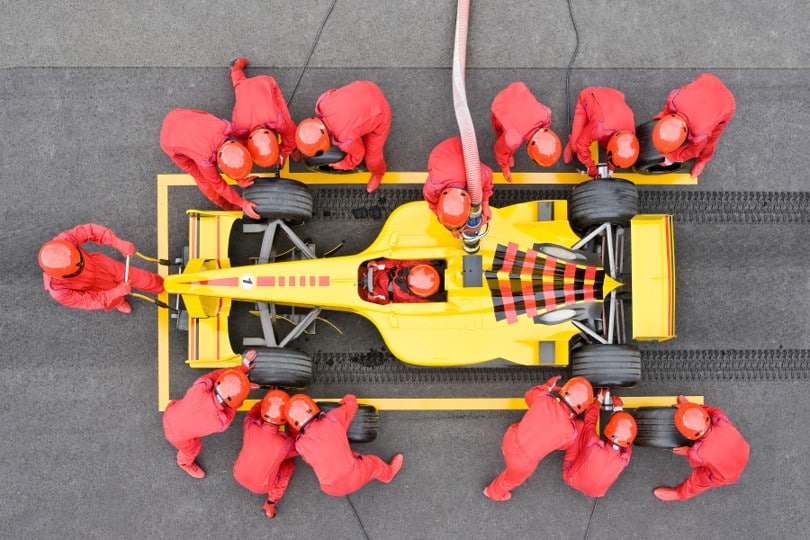
In racing, winning isn’t about who drives fastest — it’s about who can adapt fastest. Nowhere is this more obvious than in the pit stop, where seconds can win or lose a race. Pit crews operate with total synchronization, real-time communication, and flawless execution. Every move matters.
Supply chains should be no different. Yet many are still stuck planning in silos — and losing valuable time, money, and opportunity.
Part 1: The Problem with Sequential Supply Chain Planning
Traditional supply chains work in a relay race format:
-
- Demand forecasts pass to supply planning → passed to production → then to logistics and finance.
-
- Each handoff introduces delays, errors, and disconnects.
-
- By the time the full plan is formed, the market has changed.
The result: missed orders, excess inventory, firefighting, and lost revenue.
Part 2: The Pit Crew Model — A Lesson in Concurrent Planning
During a pit stop:
-
- Tire changers, fuelers, wing adjusters all work at the same time.
-
- The driver and crew chief communicate in real time.
-
- Sensors and data provide instant feedback.
-
- The entire team adapts to any changes, instantly.
In supply chain concurrent planning:
-
- Sales, supply, production, logistics, and finance all collaborate in real time.
-
- Data updates instantly across functions.
-
- Scenario planning enables proactive decision-making.
-
- Adjustments are synchronized to avoid downstream chaos.
Part 3: Why Concurrent Planning Wins — Beyond Just Speed
✅ Agility → Respond faster to disruptions and demand shifts.
✅ Alignment → Break silos and ensure all teams are working toward the same goals.
✅ Accuracy → Use real-time data to make decisions based on current reality.
✅ Resilience → Navigate disruptions without blowing up the plan.
✅ Customer Satisfaction → Meet delivery expectations and improve reliability.
Part 4: Becoming a Pit Crew-Ready Supply Chain
Winning races (and markets) requires preparation and the right tools:
➡️ Upgrade your data flow: Ensure real-time integration across systems
➡️ Align teams and roles: Define clear decision-making processes
➡️ Implement scenario planning: Test options before committing
➡️ Foster a collaborative culture: Encourage cross-functional visibility and teamwork
➡️ Choose the right technology partner: Concurrent planning platforms make this possible
Conclusion:
Just like racing, supply chain success today depends on speed, precision, and teamwork. Concurrent planning transforms supply chains from reactive and siloed to agile and aligned — giving you the competitive edge to stay ahead of disruption and win your market.
Is your supply chain stuck in sequential pit stops — or ready to run like a winning team?
Let’s start the conversation about how concurrent planning can help you shift gears.