


Every meaningful technological shift follows two remarkably different timelines.
The first is easy to recognize because it dominates headlines. New capabilities emerge, investment accelerates, software providers race to incorporate new functionality into their platforms, and organizations begin experimenting with what suddenly appears possible. Progress feels rapid, almost relentless. Each month introduces another announcement that suggests the future has arrived sooner than expected.
The second timeline is far quieter. It unfolds inside organizations rather than technology companies. Processes evolve. Responsibilities shift. New habits gradually replace old ones. Leaders reconsider how decisions should be made, what information matters most and how work flows across functions. Unlike advances in technology, these changes rarely happen quickly. They emerge through experimentation, adjustment and experience, often over many years.
History suggests that the second timeline is ultimately the one that matters most.
The technologies that reshape industries rarely create lasting value simply because they exist. They become transformative only after organizations discover new ways to work because of them. That distinction has repeated itself often enough to become almost predictable. Enterprise Resource Planning (ERP) systems dramatically improved access to information, but organizations spent years learning how to integrate planning, finance and operations around that information. Transportation Management Systems (TMS) introduced increasingly sophisticated optimization capabilities long before logistics organizations trusted automated recommendations as part of everyday decision making. Warehouse Management Systems (WMS) expanded visibility across distribution networks, yet the greatest operational improvements often followed years later, after companies redesigned labor models, management practices and operational processes to reflect what the technology made possible.
Technology changed first.
Organizations changed later.
Artificial intelligence (AI) appears to be following a remarkably similar path.
Over the past two years, AI has become nearly impossible to avoid in conversations about supply chain management. Executive meetings routinely include discussions about generative AI. Industry conferences devote entire agendas to emerging use cases. Technology vendors increasingly present AI as a foundational capability rather than a future enhancement. Even organizations that have approached adoption cautiously have begun identifying opportunities to experiment with the technology, recognizing that ignoring it entirely is no longer a realistic option.
For all of this attention, however, the reality inside most supply chain organizations remains surprisingly practical.
Few executives are attempting to reinvent their operations around artificial intelligence. Instead, they are looking for opportunities to remove friction from existing work. Planning teams are using AI to accelerate scenario analysis and prepare routine summaries. Procurement professionals are experimenting with tools that consolidate supplier information, review contracts and monitor emerging risks. Customer service organizations are reducing administrative effort by generating draft responses and organizing information more efficiently. Transportation teams are exploring how AI can investigate disruptions, summarize operational events and support planners as they respond to changing conditions throughout the network.
Viewed independently, none of these initiatives appear revolutionary. Each addresses a specific activity that has traditionally required significant manual effort. Yet collectively they reveal something more significant. Artificial intelligence is quietly becoming another participant in knowledge work. It is beginning to assist with gathering information, organizing data, drafting communications, identifying patterns and preparing analyses across nearly every function of the supply chain.
That progression feels meaningful precisely because it is so ordinary.
The current generation of AI is not transforming organizations through dramatic moments of automation. Instead, it is entering everyday work almost imperceptibly, reducing the time required to complete activities that have historically occupied a substantial portion of the workday. Each improvement may appear incremental in isolation, but together they begin to change how information moves through an organization and how quickly decisions can be supported.
Yet despite these advances, remarkably little has changed about the way most supply chain organizations are structured.
Planning departments continue to operate within familiar planning cycles. Procurement teams still manage supplier relationships through established governance processes. Transportation organizations continue to coordinate execution across carriers, distribution centers and customers much as they have for years. Organizational charts remain largely intact. Decision rights have not fundamentally shifted. Most companies continue to measure performance using the same operating rhythms that existed before AI became part of the conversation.
This apparent contradiction is worth considering.
On one hand, AI capabilities continue to improve at an extraordinary pace. On the other, the organizations adopting those capabilities appear to be changing much more slowly. It would be easy to interpret that gap as hesitation or resistance, but history suggests something different. Organizations are not simply collections of technology. They are collections of people, incentives, governance structures and accumulated experience. Altering how those elements interact has always proven more complex than introducing new software.
Perhaps that is why discussions about artificial intelligence often feel simultaneously urgent and incomplete.
Much of the conversation naturally focuses on the technology itself. Which models are improving most rapidly? Which vendors offer the strongest capabilities? Which functions should organizations prioritize first? These are important questions, particularly for leaders seeking practical ways to introduce AI into existing operations. They are also the kinds of questions that accompany almost every significant wave of technological innovation.
Less attention, however, has been devoted to a different aspect of the transition—one that may ultimately prove more consequential than any individual use case.
As AI becomes increasingly capable of supporting everyday work, how do organizations themselves begin to evolve?
A recent framework published by OpenAI offers an interesting perspective on this broader challenge. Rather than evaluating occupations solely through the lens of technical capability, the framework also considers factors such as human necessity, demand elasticity and the realities of organizational adoption. The result is a more measured view of how work is likely to change over time, acknowledging that the existence of technological capability does not automatically translate into immediate organizational transformation.
That observation extends well beyond artificial intelligence.
Organizations have always adopted technology selectively. Some innovations are embraced immediately because they solve obvious problems without disrupting established ways of working. Others require companies to reconsider deeply embedded assumptions about roles, responsibilities and decision making before meaningful value can be realized. In those cases, progress depends less on the maturity of the technology than on the willingness of leaders to redesign the organization around new possibilities.
Supply chains have experienced this pattern repeatedly over the past several decades. Visibility improved before collaboration matured. Optimization became possible before organizations consistently trusted optimization engines to influence operational decisions. Digital platforms connected information long before cross-functional decision making became commonplace. Each wave of technology created new capabilities, but the organizations that realized the greatest competitive advantage were rarely those that implemented software first. They were the ones that gradually learned how to operate differently because the technology existed.
Artificial intelligence appears poised to test that same organizational capability once again.
Its greatest contribution may not be found in any individual productivity improvement, impressive though many of those improvements are becoming. Instead, its longer-term significance may lie in the way it steadily reshapes expectations about how work should be organized, how decisions should be supported and how people contribute inside increasingly intelligent operating environments.
That possibility is still emerging, and predicting exactly where it leads would be premature. But it does suggest that the most interesting part of the AI conversation may no longer be the technology itself. It may be the gradual evolution of the organizations learning to work alongside it.
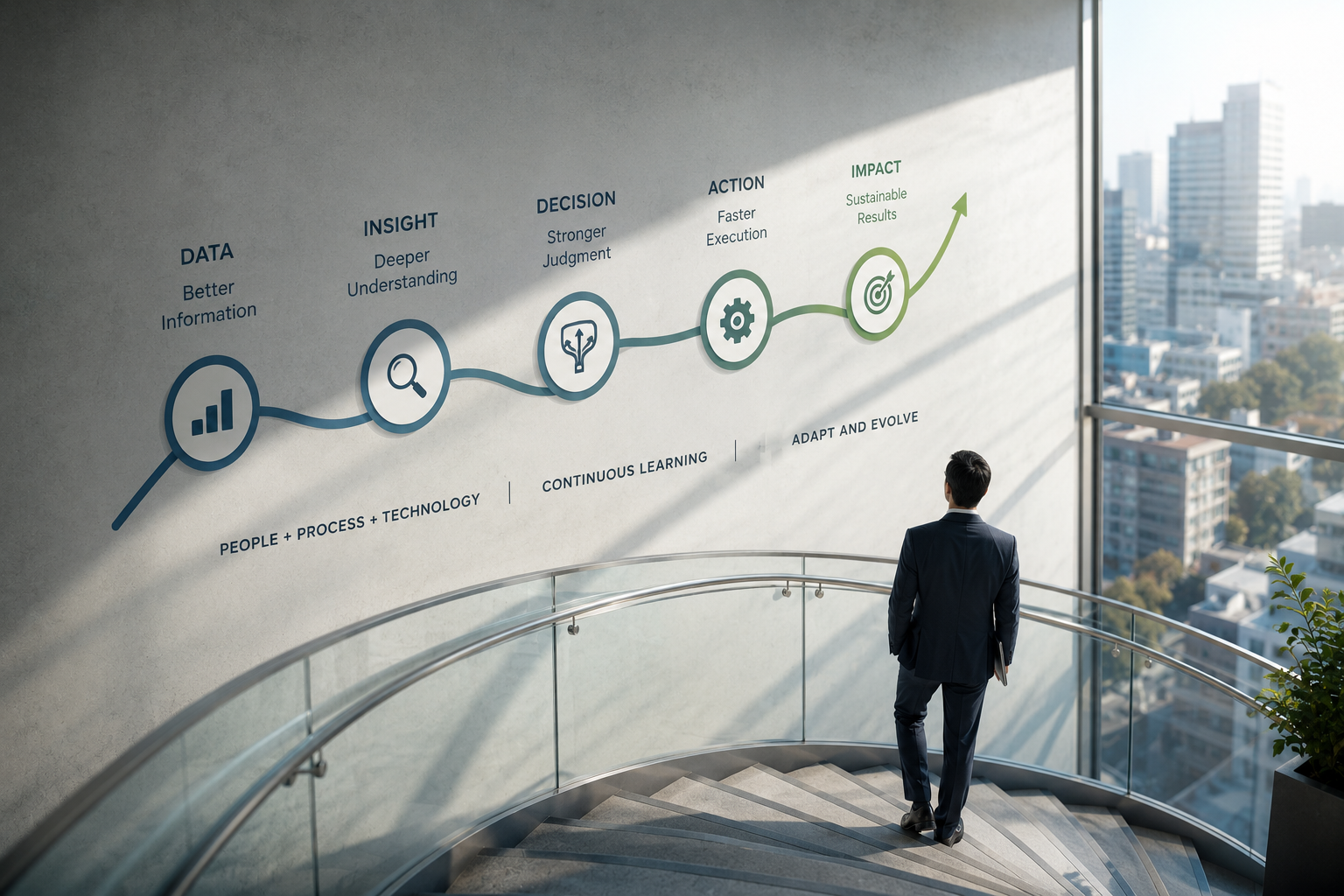
The implications of that evolution extend well beyond individual productivity.
Much of today’s discussion understandably centers on how AI can help people perform existing tasks more efficiently. Faster analyses, better summaries and quicker access to information all represent meaningful improvements. They free experienced professionals from work that is repetitive, administrative or unnecessarily time consuming. Few organizations would argue that these gains lack value.
Yet focusing exclusively on productivity risks overlooking a more subtle transformation already beginning to take shape.
Every operating model is built upon assumptions about how information moves, where expertise resides and how decisions are made. Those assumptions have historically reflected practical limitations. Information was difficult to assemble, analysis required time and experience, and communication across functions often introduced unavoidable delays. Planning therefore followed established cycles. Procurement reviews occurred at scheduled intervals. Transportation decisions were revisited as disruptions emerged rather than continuously. Governance evolved around the cadence that people could reasonably sustain.
Artificial intelligence does not simply reduce the time required to complete these activities. It begins to challenge the assumptions that shaped them in the first place.
When information can be synthesized in seconds rather than hours, when exceptions can be identified continuously rather than through periodic reviews, and when recommendations can be prepared before meetings even begin, the traditional rhythm of many supply chain processes naturally comes into question. Activities that once required structured planning cycles may gradually become more continuous. Decisions that depended on manually assembling information may increasingly begin with an informed recommendation already on the table. Coordination across functions may occur earlier because information reaches everyone at nearly the same time.
None of these changes eliminate the need for experienced professionals. If anything, they increase the importance of judgment. Data has never been the scarce resource inside supply chains. Context has. Understanding whether a supplier should be supported despite deteriorating performance, deciding whether service should take precedence over cost during a disruption, or recognizing when a recommendation conflicts with broader business strategy remain profoundly human responsibilities. Artificial intelligence may increasingly improve the quality and speed of information available to decision makers, but determining which tradeoffs best reflect an organization’s priorities continues to require leadership.
That distinction feels particularly important because conversations about AI often drift toward predictions about automation. While some activities will undoubtedly become highly automated, history offers little evidence that organizational value comes primarily from eliminating work. More often, value emerges because people begin spending their time differently.
Supply chains have already experienced this pattern.
Planning software did not make planners obsolete. It allowed them to evaluate more scenarios than had previously been practical. Network optimization did not eliminate strategy teams. It expanded their ability to understand tradeoffs across increasingly complex distribution networks. Control towers did not replace operational leadership. They gave organizations greater visibility, allowing leaders to intervene earlier and with better information.
At least in the near term, artificial intelligence appears positioned to extend that progression rather than interrupt it.
If routine analytical work increasingly becomes automated, experienced professionals may devote more attention to understanding ambiguity rather than gathering information. Cross-functional collaboration may become more important precisely because technology accelerates the flow of information across organizational boundaries. Leadership itself may gradually shift away from directing individual decisions toward designing environments where better decisions occur more consistently.
Seen from that perspective, the conversation begins to move beyond technology altogether.
For decades, many supply chain organizations have operated around periodic decision making. Planning occurs according to established calendars. Performance is reviewed through scheduled business meetings. Risks are assessed during formal governance cycles. Operational issues move through functions before reaching those responsible for broader business decisions. These approaches developed because they reflected the practical realities of how quickly information could be collected, validated and shared.
Increasingly, those constraints are beginning to disappear.
Organizations are moving toward environments where signals emerge continuously, recommendations evolve dynamically and operational insight is available almost as quickly as events themselves unfold. Decision making becomes less dependent upon periodic reporting and more dependent upon an organization’s ability to interpret and respond to changing conditions in real time.
This is not simply a technological evolution.
It represents a gradual shift in the operating model itself.
That transition is unlikely to occur all at once, nor will every organization move at the same pace. Many existing planning cycles, governance processes and organizational structures will continue to serve important purposes. Strategic decisions still require deliberation. Capital investments still demand careful evaluation. Relationships with customers and suppliers continue to depend upon trust, experience and collaboration rather than algorithms alone.
Therefore, over the next 3 – 5 years, it is unlikely to resemble a fully autonomous supply chain making decisions without human involvement.
A more plausible future is one in which artificial intelligence increasingly participates alongside people, continuously monitoring operations, surfacing emerging risks, preparing recommendations and reducing the effort required to transform information into action. Human expertise becomes more valuable, not because people perform every task themselves, but because they provide judgment, context and accountability within increasingly intelligent systems.
The organizations that adapt most successfully may not be those with access to the most sophisticated AI models. Those capabilities will become progressively more available across the market. Nor are they necessarily the organizations that automate the largest percentage of existing work. Competitive advantage has rarely proven sustainable when based solely on technology.
Instead, advantage is more likely to emerge from something considerably more difficult to replicate: an organization’s ability to continually redesign itself as technology evolves.
That capability has always distinguished leading supply chains.
The organizations that benefited most from enterprise systems were not simply those that implemented ERP software first. They were the ones that reorganized planning, finance and operations around shared information. The companies that extracted the greatest value from advanced planning systems were not necessarily those with the most sophisticated algorithms, but those that learned to trust data, collaborate differently and make decisions with greater consistency. The same pattern repeated with transportation optimization, warehouse management and digital visibility platforms. Technology expanded what was possible. Organizational adaptation determined how much value became real.
Artificial intelligence is unlikely to be an exception.
Its capabilities will continue to improve, sometimes faster than organizations expect and sometimes in ways that challenge today’s assumptions. Some predictions about its impact will almost certainly prove optimistic. Others may underestimate how profoundly everyday work evolves over the coming decade. That uncertainty is inevitable whenever a technology advances as rapidly as AI has over the past several years.
What seems easier to anticipate is something history has demonstrated repeatedly.
Technology changes the possibilities available to organizations. Leadership determines whether organizations change in response.
For supply chain executives, that may ultimately become the more enduring challenge. The conversation surrounding artificial intelligence will continue to evolve as new capabilities emerge, new applications become practical and today’s limitations gradually disappear. Yet the organizations that create lasting advantage are unlikely to distinguish themselves simply through the technologies they purchase. They will distinguish themselves through their willingness to rethink how decisions are made, how expertise is applied and how work flows across increasingly connected, increasingly intelligent operations.
Long after today’s AI models have been replaced by more capable successors, that organizational capability may prove to be the most important competitive advantage of all.
